


The world of Artificial Intelligence continues to grow unabated, but it’s still a «one-to-one» experience : you, a text window, and little else. Now, OpenAI is starting to break that mold and is dangerously approaching the territory of WhatsApp and Telegram: ChatGPT is launching group chats in select markets , and the way we interact with AI could change considerably in the coming months.
ChatGPT launches group chats: this is what the new AI-powered “WhatsApp groups” are like
OpenAI has announced a pilot program for ChatGPT group chats in a limited number of regions: Japan, New Zealand, South Korea, and Taiwan . The feature is available on both the web and mobile apps and is accessible to Free, Go, Plus, and Pro users , provided they are logged in with their account.
The idea is simple, or so it seems: invite your friends, family, or coworkers to the same chat… where ChatGPT is also present . The AI then acts as an advisor, referee, or secretary, taking notes while the group discusses. It’s a concept we’ve already seen in Copilot and WhatsApp itself with Meta AI, but now it’s integrated into the most popular AI service of the moment. We’ll see if it remains a pilot program or if people actually use it.
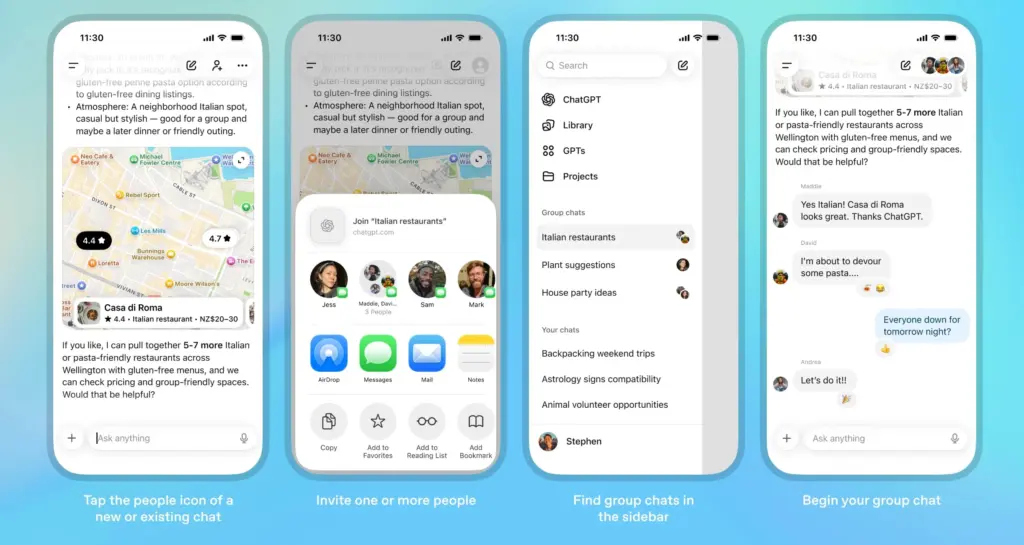
What exactly are ChatGPT group chats?
ChatGPT’s new group chats allow up to 20 human participants in a single conversation , in addition to the assistant itself. The question is whether this will be useful and able to compete with WhatsApp or Telegram, or if it will be a one-off feature. Some key details:
-
They are created from an existing chat by tapping the people icon in the upper right corner.
-
ChatGPT duplicates the individual conversation and generates a group version, keeping the original history intact.
-
You can invite others using a shareable link , which works up to that limit of 20 people.
In practice, this allows for mundane things like organizing a dinner party or a trip with friends, but also coordinating a class project, a team meeting, or website content planning… with AI taking notes, summarizing ideas, and suggesting alternatives. The question remains, will it actually be useful?
An assistant who decides when to speak (and when to be silent)
The groups run on GPT-5.1 Auto , OpenAI’s latest model for ChatGPT, with features such as integrated search, file upload, image generation, and voice dictation.
There are several interesting details about AI behavior:
-
He doesn’t respond to everything : he follows the flow of the group and decides when to intervene.
-
You can force a response by mentioning “ChatGPT” in the message.
-
You can react with emojis and use participants’ profile pictures to create custom images within the group.
-
Usage limits ( the typical «you have run out of messages per hour») only apply when the AI responds , not when humans talk to each other.
Privacy and control: the serious part of the experiment
OpenAI insists that group chats are separate from your private conversations and that ChatGPT’s personal memory isn’t shared with the rest of the group —a crucial point when you’re mixing work, personal life, and an assistant that remembers almost everything. But this raises a significant privacy issue that OpenAI can’t ignore.
Besides:
-
The groups are by invitation only and any member can leave at any time.
-
There are additional filters for those under 18 , with parental control systems and enhanced moderation.
It is undoubtedly a delicate move: turning ChatGPT into something more like a «super-social app» involves managing not only prompts, but also group dynamics, harassment, spam, and misinformation .
This new development comes shortly after other clearly “social” movements, such as the AI-generated short video app, Sora, and in a context where Meta already allows its AI to be invoked within WhatsApp groups.
Perhaps in certain areas the use of AI is being forced and it’s not necessary. The reality is that AI can be very useful in some cases, while in others it’s merely symbolic. We’ll see if this new attempt by OpenAI works or disappears before it even reaches Spain.